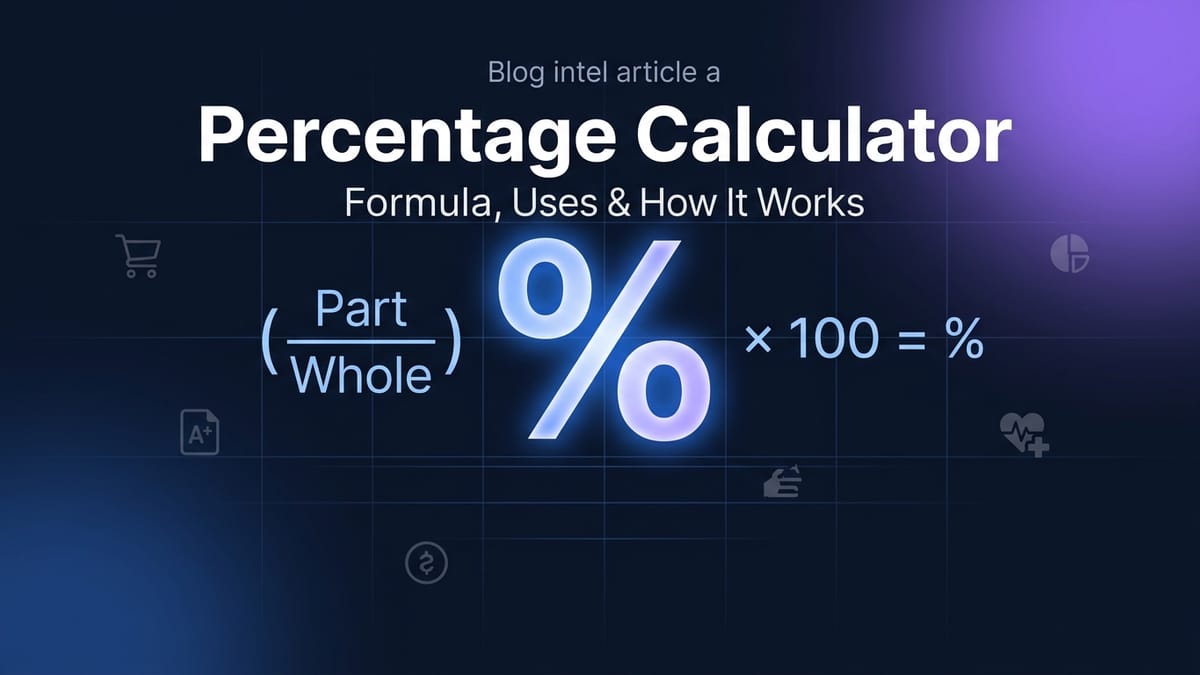
Have you ever stared at a restaurant bill wondering how to split a 15% tip, or stood in a clothing store trying to figure out a 30% discount before pulling out your smartphone? While digital devices are ubiquitous, mastering how to calculate percentage without calculator remains one of the most empowering, practical arithmetic abilities in modern daily life.
Whether you need to figure out a percentage during a business negotiation, verify sales tax at checkout, or help your kids with homework, relying purely on mental arithmetic and basic manual methods builds agility and financial confidence. In this comprehensive guide, we unpack every reliable technique — from the fundamental decimal-shift method to lightning-fast mental math shortcuts, calculator operations, and a complete percentages without calculator worksheet with step-by-step solutions.
Why Mental Math Skills Still Matter
In a world filled with pocket supercomputers, it is fair to ask: why work out math by hand when you can tap a screen?
- Instant Decision-Making: When shopping or negotiating, taking 30 seconds to unlock your phone breaks your flow. Doing a rapid mental estimation or exact computation in 3 seconds gives you an immediate advantage.
- Preventing Costly Calculation Errors: Blind reliance on digital tools makes it difficult to spot erroneous data entry. A solid grasp of mental percentages allows you to immediately recognize if a quoted price or interest rate is wildly off.
- Cognitive Sharpness & Number Sense: Practicing mental arithmetic exercises your working memory, reinforces understanding of place value, and deepens your intuition for fractions, proportions, and financial figures.
- Calculated Confidence: In language, to calculate means both to compute arithmetic values mathematically and to evaluate scenarios strategically (taking a “calculated risk”). Mastering arithmetic empowers both forms of calculation.
The Manual Method (Step-by-Step)
The manual, pen-and-paper method is the foundational standard for computing any percentage. It requires no guesswork and breaks down into two straightforward arithmetic steps: decimal conversion and multiplication.
Step 1: Convert the Percentage to a Decimal
Every percent is inherently a fraction with a denominator of 100 (per centum = “per hundred”). To transform a percentage into its decimal equivalent:
- Take the percentage number and shift its decimal point two places to the left.
- If working with a single-digit percent, insert a leading zero as a placeholder (for example, 7% becomes 0.07).
0.050.150.250.60 (or 0.6)1.25Step 2: Multiply the Decimal by the Whole Number
Once converted to a decimal, multiply it directly by the total amount (the whole).
Part = Decimal x WholeStep-by-Step Worked Examples
Example A: Finding 25% of $80 (Discount Scenario)
- Convert to decimal: 25% = 25 / 100 = 0.25
- Multiply: 0.25 x 80
- Compute: (1/4) x 80 = 20
- Answer: 25% of $80 is $20 (Sale Price = $80 - $20 = $60).
Example B: Calculating a 15% Tip on a $64 Restaurant Bill
- Convert to decimal: 15% = 0.15
- Multiply: 0.15 x 64
- 0.10 x 64 = 6.40
- 0.05 x 64 = 3.20
- 6.40 + 3.20 = 9.60
- Answer: The 15% tip is $9.60 (Total bill = $64 + $9.60 = $73.60).
Mental Math Shortcuts (Calculate in Seconds)
You do not always need paper and pencil to compute percentages. By utilizing benchmark numbers and arithmetic symmetry, you can solve almost any percent no calculator problem in your head in under five seconds.
1. The 10% Foundation Rule
To find 10% of any number, simply move the decimal point one place to the left. Once you have 10%, you can scale to almost any percentage.
Example: Find 20% & 30% of $140
• 10% of $140 = $14
• 20% = 10% × 2 = $14 × 2 = $28
• 30% = 10% × 3 = $14 × 3 = $42
2. The 5% & 15% Splitting Trick
5% is always exactly half of 10%. To compute 15%, find 10%, halve it to get 5%, then add them together (10% + 5%).
Example: Find 15% of $80
• 10% of $80 = $8.00
• 5% = half of $8 = $4.00
• 15% = $8.00 + $4.00 = $12.00
3. The 50%, 25%, and 12.5% Cascade
50% is half (divide by 2). 25% is half of that (divide by 4). 12.5% is half of that (divide by 8). Rapidly divide by 2 repeatedly.
Example: Find 25% of 160
• 50% of 160 = 80
• 25% of 160 = half of 80 = 40
4. The Commutative Flip (x% of y = y% of x)
Percentages are mathematically commutative: x% of y equals y% of x. If one direction is tricky, reverse it!
Example: What is 16% of 50?
• Flip it: What is 50% of 16?
• 50% of 16 = half of 16 = 8 (Instant!)
The 1% Precision Method
Need to calculate an irregular percentage like 7% or 13%?
- Find 1%: Move the decimal point two places to the left (1% of 400 = 4).
- Multiply: For 7%, compute 4 x 7 = 28.
- For 13%, compute (10% of 400) + (3 x 1% of 400) = 40 + (3 x 4) = 52.
Using a Calculator (Basic vs Scientific vs Online)
When dealing with complex numbers, high precision, or large datasets, calculators speed up the workflow. Here is how percentage calculation works across different device types:
Basic Handheld Calculator
Standard 4-function desktop calculators possess a dedicated % button, but its operation can be tricky depending on brand firmware.
- To find 15% of 200: Enter
200 × 15 %(Displays 30) - To add 10% tax: Enter
100 + 10 %(Displays 110) - Warning: Always test your specific calculator model’s % key logic.
Scientific / Graphing Calculator
Scientific calculators (e.g. TI-84, Casio fx) follow strict standard algebraic order of operations (BODMAS/PEMDAS).
- Direct decimal input:
0.15 × 200 = 30 - Fraction key support:
(15 / 100) × 200 - Handles complex compounding and multi-step formulas
Online Percentage Calculator
Web-based tools provide instant bidirectional calculations without needing manual formula rearrangement.
- Computes “X is what % of Y”, percentage change, and discounts
- Zero syntax errors or keystroke ambiguities
- Step-by-step arithmetic visual breakdown built-in
Practice Worksheet: Percentages Without Calculator
Put your mental math and manual calculation skills into practice. Complete these 8 real-world practice problems without using any digital device, then toggle each question to check your solution.
Percentages Without Calculator Practice Worksheet
8 problems covering mental arithmetic, discounts, markups, test scores, and tax.
Show Step-by-Step Solution▼
• 10% of 350 = 35
• 20% = 35 × 2 = 70
Show Step-by-Step Solution▼
• 50% of $240 = $120
• 25% = half of $120 = $60
Show Step-by-Step Solution▼
• Reverse: 50% of 18
• 50% of 18 = half of 18 = 9
Show Step-by-Step Solution▼
• 10% of $84 = $8.40
• 5% = half of $8.40 = $4.20
• Total Tip = $8.40 + $4.20 = $12.60
Show Step-by-Step Solution▼
• 10% of $120 = $12
• 30% discount = $12 × 3 = $36
• Final Price = $120 - $36 = $84
Show Step-by-Step Solution▼
• Scale denominator to 100: Multiply top & bottom by 2
• (38 × 2) / (50 × 2) = 76 / 100 = 76%
Show Step-by-Step Solution▼
• 1% of $500 = $5.00
• 6% = $5.00 × 6 = $30.00 tax
Show Step-by-Step Solution▼
• 50% of 60 = 30; 5% of 60 = 3
• 45% = 50% - 5% = 30 - 3 = 27
Common Mistakes to Avoid
Even seasoned professionals occasionally make avoidable mental arithmetic errors. Watch out for these four common pitfalls:
- Shifting the Decimal Point in the Wrong Direction:
- Error: Treating 8% as 0.8 instead of 0.08. Multiplying by 0.8 actually calculates 80%, giving a result ten times larger than intended!
- Dividing Instead of Multiplying with Decimals:
- When calculating a percentage of a number, you multiply by the decimal (0.25 x 80 = 20). Dividing by 0.25 would give 320.
- Confusing Percentage Increase with the Final Amount:
- Adding 20% to $50 gives a $10 increase, resulting in a total of $60. Make sure you know whether the problem asks for the markup amount ($10) or the total final price ($60).
- Assuming Successive Discounts Add Up Directly:
- A store offering “20% off plus an extra 20% off” is not offering a 40% discount. The second 20% applies only to the already reduced price (yielding a net discount of 36%).
Frequently Asked Questions
How do you calculate a percentage without a calculator?
The quickest method is using 10% as a benchmark. Find 10% by shifting the decimal point one place left. Double it for 20%, halve it for 5%, or combine them (10% + 5%) for a 15% tip. For exact manual math, convert the percentage into a decimal by dividing by 100, then multiply by the total number.
What is the trick for x% of y = y% of x?
Because multiplication is commutative, finding x% of y is algebraically identical to finding y% of x. For instance, finding 12% of 25 is difficult in your head, but flipping it to 25% of 12 (one quarter of 12) is instantly solved as 3.
How do you calculate a test score percentage manually?
Divide your score (the part) by the maximum possible score (the whole), then multiply by 100. If the total possible score easily scales to 100 (such as 20, 25, or 50), multiply both the top and bottom by the scaling factor (e.g., scoring 18/20 = multiply both by 5 = 90/100 = 90%).
How do I convert a fraction into a percentage?
Divide the numerator by the denominator to obtain a decimal fraction, then shift the decimal point two digits to the right (multiply by 100) and append the % symbol. For example: 3/8 = 0.375 = 37.5%.
Need Instant, 100% Precise Results?
Try our free online percentage calculator for immediate calculations with zero room for error.